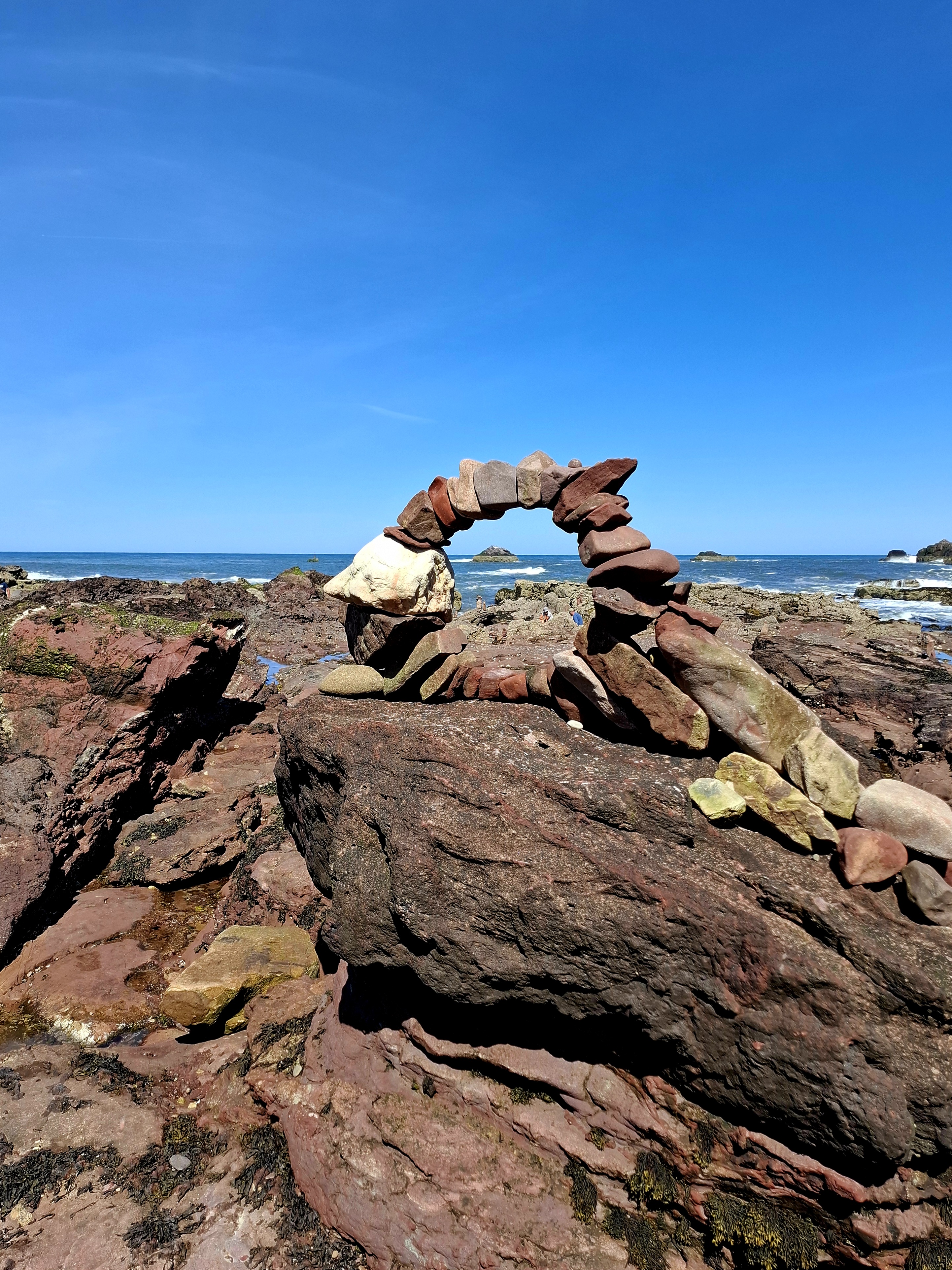
Stone stacking and mindfulness in motion
The European Land Art Festival landed in Dunbar, Scotland this weekend. I'm a huge advocate of mindful meanderings in Nature for mental wellbeing, and an art-lover of all forms. I leapt at the chance to combine them on a sunny summer day.
The East Lothian town’s most famous son, naturalist John Muir said "into every walk with nature, one receives far more than he seeks." I imagine he would have been happy to stumble upon his portrait made of pebbles and other found materials, and the whole spirit of the festival. For me, the day served as a reminder that immersing ourselves in the natural world offers a uniquely restorative space for psychological groundedness, interconnectedness and self-regulation.
At the heart of activities was the practice of stone stacking, which offers profound therapeutic benefits. Finding the center of gravity between rocks and stones requires focus, fine motor control, and patience. As you feel the weight, texture, and nature of each stone, the nervous system naturally begins to calm. The internal chatter gives way to physical awareness. You need to observe and feel without rushing, helping to slow down, to regulate breathing, and trusting the process of finding balance, both externally and internally.
Rather than sitting in static meditation, land art engages the whole body, bending to lift stones, pacing out lines in the sand, all while feeling the breeze and observing textures. This is a dynamic, embodied awareness that brings us fully into the present moment, entering into a state of creative flow. The mind then can stop dwelling on past regrets or future worries, finding an anchor in stone, sand, and sky.
Dotted along the shore were intricate mandalas drawn into the sand and arranged with pebbles. In psychology, the mandala has long been recognized as a symbolic representation of the self, and a tool for restoring internal order. Organising scattered natural elements into radial symmetry creates a visual sanctuary of balance next to the gentle, yet wild chaos of the coastline. Building a mandala helps externalize our need for structure, transforming internal chaos into pleasing geometry.
Perhaps the festival’s most poignant lesson lies in its awareness of impermanence. Land art is inherently fleeting. These creations are swallowed by the waves in a matter of hours. In therapeutic terms, this can offer a visceral practice in not holding on too tightly to ideas, possessions or outcomes. Life, like the shoreline, is constantly shifting, and learning to appreciate beauty in its temporary state, helping us make peace with the inevitable changes and losses. Afterall, it is experiences and connections with Ourselves, Others, and Nature that give meaning to our lives, and there is no ultimate protection against loss.