Trauma, Dehumanisation and Dignity in Death
Son of Saul: A Therapist's Review
By Zsofia Kaplar | First published in Therapy Today, the magazine of the British Association of Counselling and Psychotherapy (BACP), 2016
In a previous life, in mid-1990s Budapest, I worked as a journalist for an English language weekly. My favourite remit was the arts section — I was paid to watch pre-release films during the day, then write about them.
So when Son of Saul came out a couple of decades later, I felt drawn to writing a film review again. This time for Therapy Today, the magazine of the British Association of Counselling and Psychotherapy — my professional membership organisation at the time. The prompt felt fitting. After all, art is therapy, and therapy is art.
Some stories are set in a specific time and place. Their questions are universal.
https://www.researchgate.net/publication/305082711_therapy_today
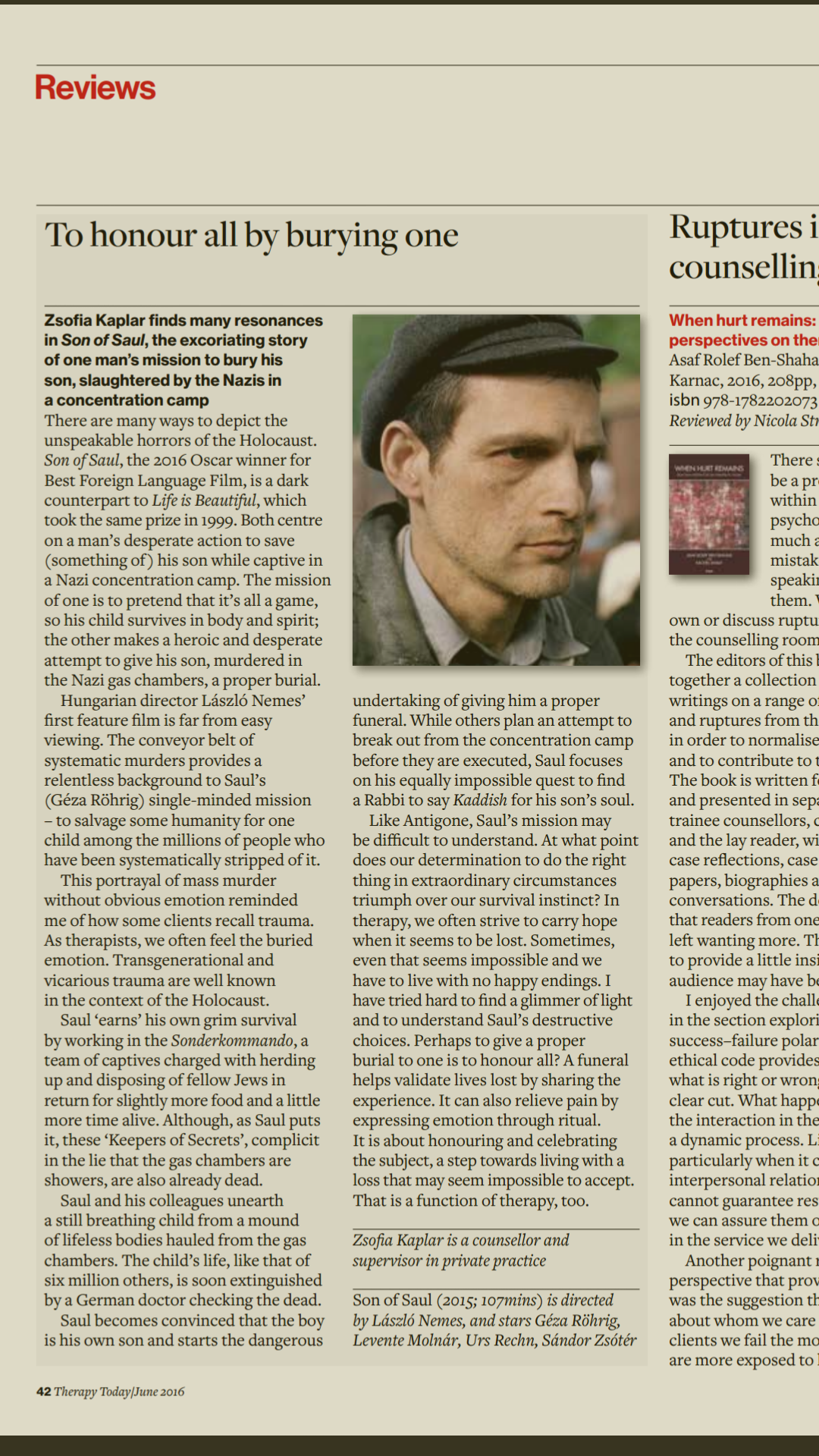
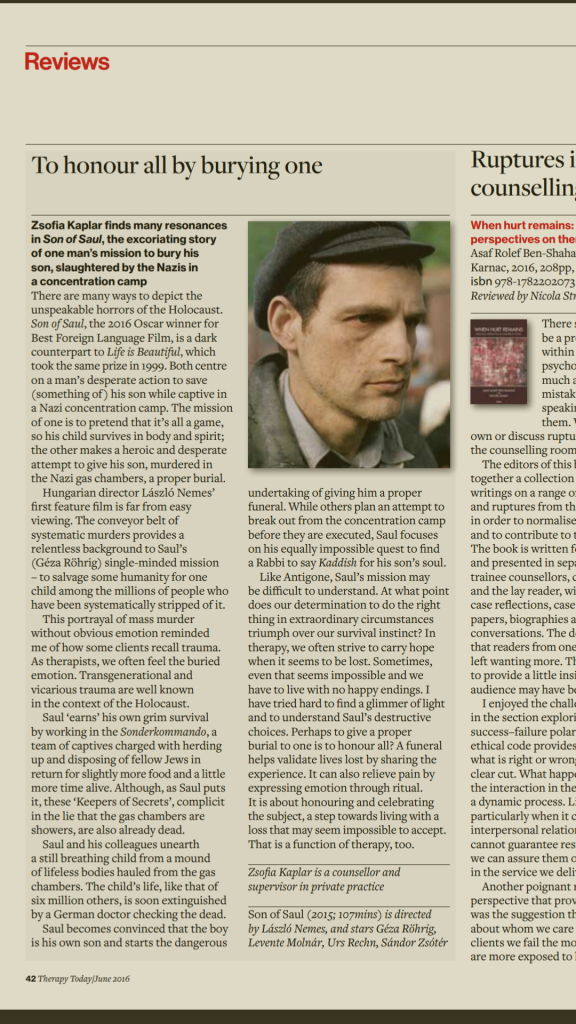
"There are many ways to depict the unspeakable horrors of the Holocaust. Son of Saul, the 2016 Oscar winner for Best Foreign Language Film, is a dark counterpart to Life is Beautiful, which took the same prize in 1999. Both centre on a man's desperate attempt to save something of his son while captive in a Nazi concentration camp.
One father's mission is to pretend it's all a game, so his child survives in body and spirit. The other makes a heroic and desperate attempt to give his son, murdered in the gas chambers, a proper burial.
Hungarian director László Nemes' debut feature is far from easy viewing. The conveyor belt of systematic murders provides a relentless backdrop to Saul's (Géza Röhrig) single-minded mission — to salvage some humanity for one child among the millions who have been systematically stripped of it.
This portrayal of mass murder without obvious emotion reminded me of how some clients recall trauma. As therapists, we often feel the buried emotion beneath the surface. Transgenerational and vicarious trauma are well understood in the context of the Holocaust, and this film captures both with quietly devastating effect.
Saul earns his own grim survival by working in the Sonderkommando — a team of captives charged with herding and disposing of fellow Jews in return for slightly more food and a little more time alive. And yet, as Saul puts it, these "Keepers of Secrets," complicit in the lie that the gas chambers are showers, are themselves already dead.
When Saul and his colleagues pull a still-breathing child from a mound of lifeless bodies hauled from the gas chambers, a brief, impossible flicker of hope appears. It is swiftly extinguished by a German doctor confirming the dead. Saul becomes convinced the boy is his own son, and begins the dangerous undertaking of giving him a proper funeral. While others plan a breakout from the camp before they are executed, Saul pursues his equally impossible quest — to find a Rabbi to say Kaddish for his son's soul.
Like Antigone, Saul's mission may be difficult to understand. At what point does our determination to do the right thing in extraordinary circumstances triumph over the survival instinct? In therapy, we often strive to carry hope when it seems lost. Sometimes even that feels impossible, and we must learn to live with no happy endings.
I have tried hard to find a glimmer of light in Saul's choices, and perhaps this is it: to give a proper burial to one is to honour all. A funeral validates lives lost by making grief a shared experience. It can also relieve pain by expressing emotion through ritual — honouring and celebrating the person, and taking a step toward living with a loss that may seem impossible to accept.
That, too, is a function of therapy."
This review was written in 2016. The questions it raises — about cruelty, dehumanisation, survival and what it means to honour a human life — belong to no single moment, or people in history. They are, sadly, always with us.
Zsofia Kaplar is a counsellor and supervisor in private practice in Edinburgh.
Son of Saul (2015, 107 mins) is directed by László Nemes and stars Géza Röhrig, Levente Molnár, Urs Rechn and Sándor Zsótér.